Have you ever glanced at your nails and wondered whether those ridges, discoloration, or cracks signify more than just bad manicure luck? What if your nails are silently sending signals about your internal health?
Your nails are more than decorative appendages they function like little windows into your body. Subtle changes in color, texture, growth, or shape can be early indicators of nutrient deficiencies, systemic diseases, or hidden health issues. (In fact, nail changes are often overlooked in physical exams.)
In this article, you’ll discover:
- How to interpret common and uncommon nail signs
- The science behind these indicators
- What steps to take (and when to seek medical help)
- Practical routines and preventive hygiene
Whether you’re a health-conscious reader, beauty blogger, or simply curious: this guide will help you decode what your nails might really be telling you.
Nail Anatomy & What “Normal” Looks Like

Before digging into abnormalities, it’s helpful to know what constitutes a healthy nail.
- Nails are composed of keratin layers produced by the nail matrix (the root).
- A “normal” nail is smooth, uniform, pinkish in the nail bed, and translucent in the plate.
- The lunula (crescent-shaped pale area at the base) should be visible in many nails.
- Nails grow roughly 0.1 mm per day (fingernails) and ~0.05 mm/day (toenails) in healthy adults. (Growth varies with age, nutrition, and health.)
If your nails deviate from these norms, don’t panic but pay attention. Many changes are benign or temporary, but some warrant further evaluation.
1. Discoloration & Color Clues
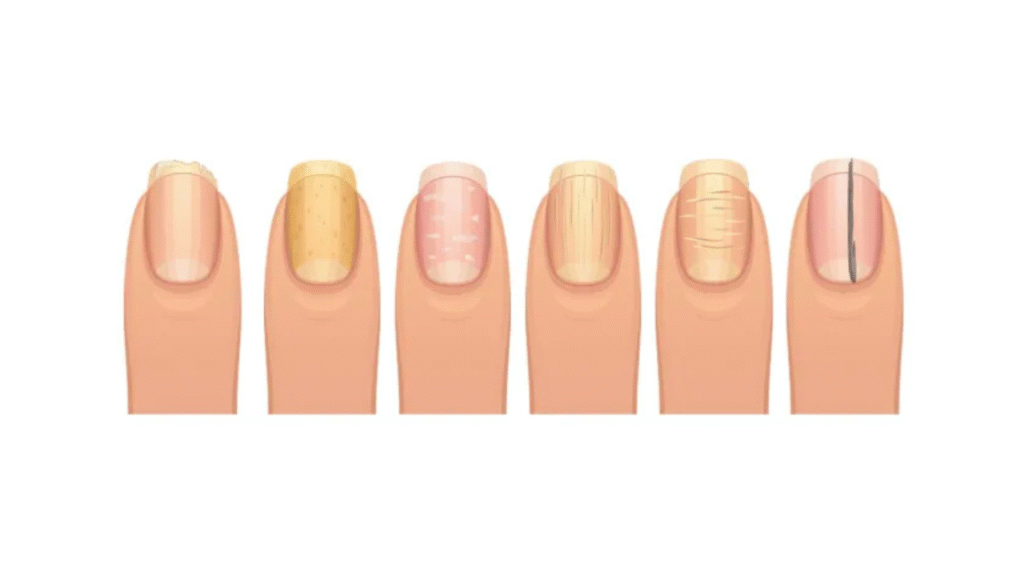
A. Yellow Nails
What you see: Nails that turn yellowish, thicken, crumble, or detach.
Possible causes:
- Fungal infection (onychomycosis): The most common cause of yellow, crumbly, thickened nails.
- Smoking or staining: Repeated exposure to nail polish, chemicals. WebMD+1
- Underlying disease (rare): Lung disease, thyroid disorders, diabetes, psoriasis.
Actionable steps:
- Try an over-the-counter antifungal product for several weeks (if fungal is suspected).
- Reduce staining factors (avoid yellow-hued nail polish, harsh chemicals).
- If no improvement in 4–6 weeks, consult a dermatologist for fungal culture or biopsy.
Caution: Don’t self-diagnose serious disease solely from yellowing; use it as a clue, not a conclusion.
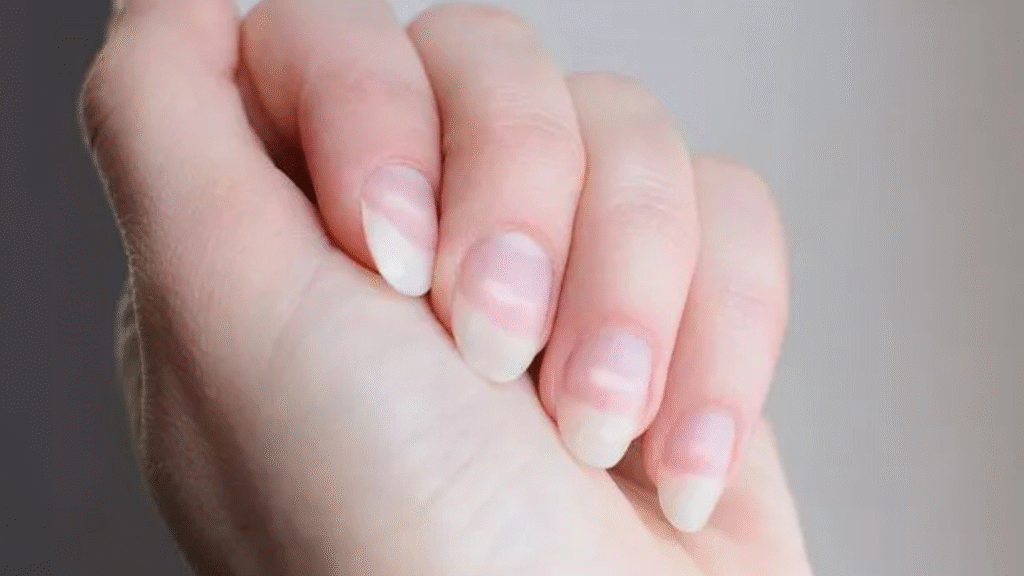
B. Pale or White Nails (Leukonychia or Very Pale Nails)
What you see: Nails look very white or “washed out.” Small white spots are common.
Possible causes:
- Minor trauma or microinjury of the nail matrix (common cause of white spots).
- Systemic issues: Anemia, liver disease, malnutrition, renal disease.
- Leukonychia subtypes may correlate with arsenic poisoning, heavy metals, systemic stress. Muehrcke’s lines (paired white lines across nail bed): associated with low albumin (hypoalbuminemia).
Actionable steps:
- Monitor if white spots move outward as nail grows (trauma origin).
- Check diet: ensure adequate protein, iron, zinc.
- If broad discoloration affects multiple nails, get blood work (CBC, liver/kidney function).
Caution: Large, persistent white bands may require evaluation for systemic disease.
C. Bluish or Purplish Nails
What you see: Nails or nail beds appear blue, purple, or dusky.
Possible causes:
- Low oxygenation (cyanosis): Could be a sign of respiratory or cardiovascular issues.
- Raynaud’s phenomenon: Poor peripheral circulation causing temporary bluing.
- Medication side effects or methemoglobinemia (rare).
Actionable steps:
- Check for accompanying symptoms: shortness of breath, chest pain, fatigue.
- If persistent, see a physician for oxygen saturation, cardiac/respiratory evaluation.
D. Dark Streaks, Spot or Bands (Melanonychia, Splinter Hemorrhage)
What you see: Vertical or horizontal dark brown, black, or red lines under the nail.
Possible causes:
- Melanonychia: Activation of melanocytes resulting in pigment production. May be benign (racial) or malignant (melanoma).
- Splinter hemorrhages: Tiny red or brownish lines small capillary bleeds. Linked to trauma, endocarditis, psoriasis.
- Medications or trauma: Some drugs, injuries can cause pigmentation changes.
When to worry:
- If a dark band is new, widening, or affecting a single nail seek dermatologic evaluation to rule out melanoma.
Actionable steps:
- Monitor width, color changes, and evolution.
- Photograph periodically.
- Consult dermatologist for dermoscopy and possible biopsy.
2. Texture, Shape & Structural Changes
A. Longitudinal Ridges or Lines
What you see: Vertical ridges running from cuticle to tip.
Possible causes:
- Ageing: Very common with aging and usually benign.
- Onychorrhexis (brittle longitudinal splits): can hint at thyroid disease, nutritional deficiency, anorexia.
- Local trauma or repeated pressure.
Actionable steps:
- Use a gentle nail file to smooth minor ridges.
- Boost hydration and nutrition (biotin, protein).
- If ridging is pronounced and sudden, consider thyroid or systemic screening.
B. Transverse Grooves / Depressions (Beau’s Lines)
What you see: Horizontal indentations or ridges across the nail.
What they may indicate:
- Temporary disruption of nail matrix growth due to illness, injury, chemotherapy, infections.
- Chronic diseases like uncontrolled diabetes, vascular disease, severe stress.
Actionable steps:
- Use the position of the ridge relative to cuticle to estimate when the stress event occurred (given growth rate ~0.1 mm/day).
- If multiple nails affected, assess for systemic causes (illness, chemotherapy exposure, malnutrition).
- Once the causative stressor is removed, the nail should grow out normally.
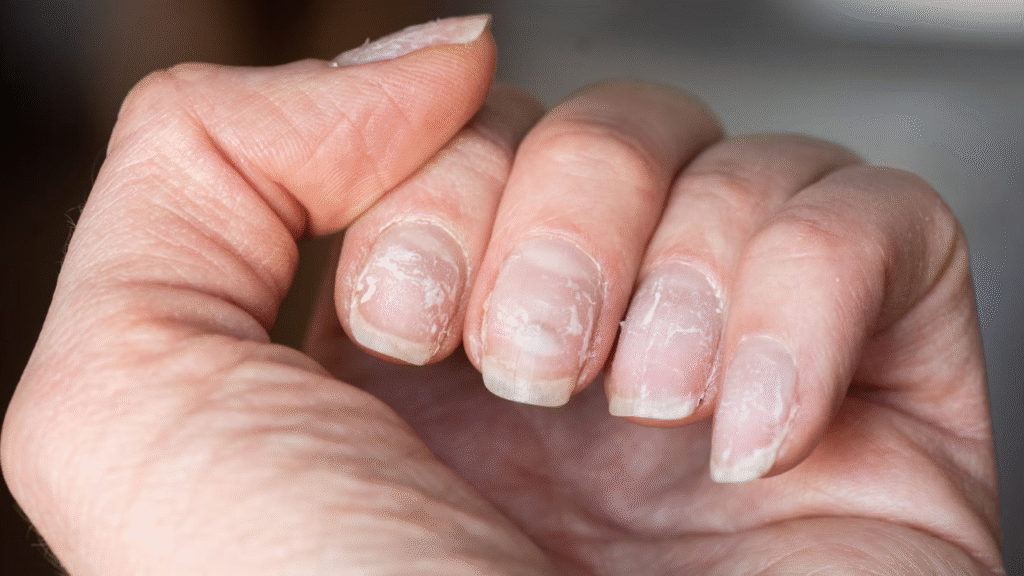
C. Nail Splitting, Brittle or Soft Nails (Onychoschizia)
What you see: Nail layers peeling, splitting horizontally or longitudinally, brittleness.
Potential causes:
- Repeated wet-dry cycles (hands constantly wet).
- Overuse of nail polish removers, harsh chemicals.
- Nutritional deficiencies: iron, selenium, zinc.
- Thyroid disease or systemic illness.
Actionable steps:
- Limit prolonged exposure to water; wear gloves for chores.
- Use moisturizing nail oils (cuticle oil, vitamin E).
- Take biotin or micronutrients if deficient (after lab confirmation).
- Avoid harsh manicure procedures.
D. Nail Thickening (Onychauxis)
What you see: Nails become abnormally thick but maintain shape. Wikipedia
Possible causes:
- Repeated trauma or pressure (especially in toenails).
- Psoriasis, fungal infection, certain skin diseases.
- Some systemic diseases like acromegaly.
Actionable steps:
- Gently file or debride thickened nail.
- Evaluate for fungal infection or skin disease.
- If unexplained, see dermatology for underlying cause.
E. Clubbing of the Nails
What you see: Tips of fingers enlarge and nails curve downward; nail bed feels spongy.
Why it matters: Strongly associated with chronic lung disease, heart disease, pulmonary issues.
Mechanism (still under research): Increased blood flow and vascular changes lead to overgrowth of connective tissue at fingertips.
Actionable steps:
- Evaluate for respiratory symptoms (cough, breathlessness).
- Seek medical evaluation (chest imaging, ECG, cardio-pulmonary tests).
- Clubbing is seldom reversed but monitoring underlying cause is key.
3. Emerging Nail Health Clues
Nail Mineral Composition & Bone Health
Some studies suggest nail mineral content (e.g. calcium, magnesium) correlates with bone metabolism and systemic mineral changes. However, this is still exploratory and not widely used clinically.
Nailfold Capillary Analysis
In rheumatology, observing capillaries around the base of the nail (nailfold capillaroscopy) can help detect autoimmune or vascular disorders (e.g. systemic sclerosis).
These advanced techniques show nails are increasingly valued in medical diagnostics but for everyday readers, the more obvious signs are of primary interest.
When Should You Worry? Red-Flag Nail Changes
Here’s a quick “check engine” list:
- A dark brown/black streak in one nail that is widening or changing (possible melanoma)
- New clubbing of multiple nails
- Beau’s lines across many nails after an unexplained illness
- Persistent thickening and detachment despite treatment
- Sudden severe brittleness across all nails
If you see these, seek professional evaluation (dermatologist, internist).
Practical Daily Nail Health Routine
Here’s a simple nail health routine you can start today:
| Step | Frequency | What to Do | Why / Notes |
|---|---|---|---|
| Trim & file | Weekly | Use gentle file, round edges slightly | Prevent snagging |
| Hydrate & oil | Daily (evening) | Apply cuticle oil (jojoba, vitamin E) | Keeps nail matrix nourished |
| Wear gloves | During chores | Protect from water, detergents | Prevents splitting & brittleness |
| Supplement (if needed) | After lab test | Take iron, zinc, or biotin | For deficiencies (not blindly) |
| Inspect monthly | Monthly | Photograph & note changes | Track trends over time |
| Avoid harsh chemicals | As much as possible | Use gentle removers | Reduces damage |
| Medical check-up | Yearly or sooner | Bloodwork, thyroid, systemic check | Especially if noticing multiple changes |
Over time (4–8 weeks), you should begin to see improvements nails grow slowly, so don’t expect overnight transformations.
FAQs
Q1: What do white spots on nails mean?
White spots are usually harmless, caused by microtrauma to the nail matrix. They generally grow out as the nail does. (Leukonychia)
Q2: Can nail changes indicate serious disease?
Yes, in some cases. Changes like clubbing, dark streaks, Beau’s lines, or profound discoloration may point to heart, lung, liver, kidney, or systemic disease. But they are clues, not diagnoses.
Q3: How long does it take for nails to reflect improved health?
Fingernails grow ~0.1 mm/day, so meaningful change can take 6–12 months. Minor improvements (less splitting, better shine) may show in weeks.
Q4: Are things like ridges always bad?
Not necessarily. Vertical ridges are common with age and often benign. Sudden deep ridges or horizontal lines (Beau’s) should be monitored.
Q5: Should I test myself?
Don’t jump to conclusions. Use changes as prompts to consult physicians. Self-treatment is okay for cosmetic issues; persistent changes need expert evaluation.